Wednesday, 15 August 2012

.:Text from Dog:.

Witam po dość długiej przerwie!
Przygotowałem coś dla fanów smsującego Psa - bohatera strony http://textfromdog.tumblr.com/ - który udzielił jakiś czas temu bardzo przaśnego wywiadu dla Guardiana [oryginał jest tutaj].
Enjoy!
---
Tłumaczenie: Krystian Iwaniuk (all rights reserved)
Oryginał:Stuart O'Connor


Text From Dog: "Mam gumowego hamburgera, który piszczy!"
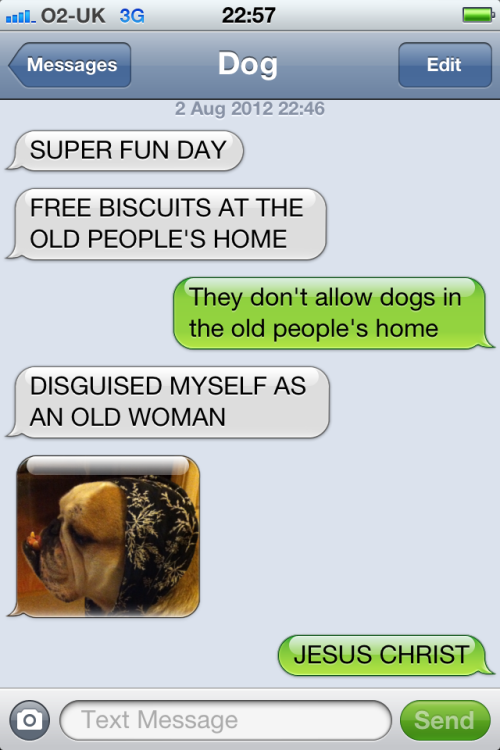
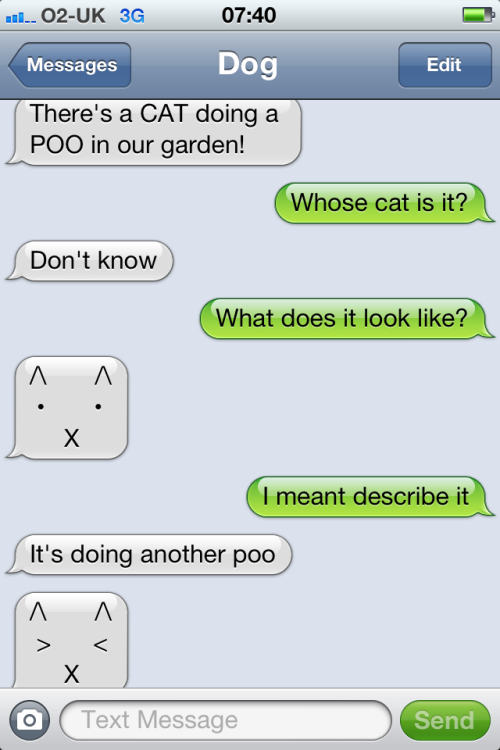
Pies - gwiazda strony Text From Dog – zrobił sobie małą przerwę od denerwowania swojego właściciela żeby podzielić się z nami swoimi przemyśleniami na temat technologii... i boczku!
 text-from-dog
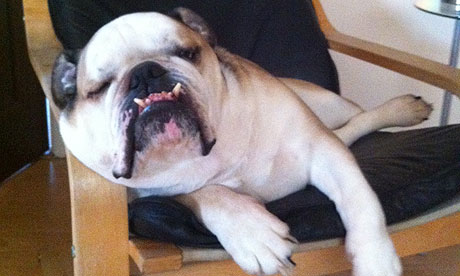
Batdog odpoczywa po ciężkim dniu pełnym walki ze złoczyńcami i obsikiwaniem rzeczy

Jaki jest twój ulubiony elektroniczny gadżet, i w jaki sposób usprawnił on twoje życie?
Mam gumowego hamburgera, który piszczy. Jest naprawdę niekiepski, ale chyba nie da się go zaliczyć do "gadżetów". Mam telefon komórkowy, na którym nauczyłem się pisać SMSy. Nie usprawnił mojego życia jakoś szczególnie. Może gdybym był człowiekiem, to bym gadał coś w stylu: "Mój telefon jest NIESAMOWITY! Nie wyobrażam sobie ŻYCIA bez niego". Na szczęście jestem psem. Ludzie to idioci.

Kiedy ostatni raz go użyłeś, i w jakim celu?
Dwie minuty temu. Wysłałem SMSa do gościa, który się mną "zajmuje". Napisałem: "Kup ciastka". Wysłałem mu to 29 razy, tak żeby nie zapomniał. Teraz mnie wyzywa. Właśnie tego rodzaju rzeczy muszę znosić.

Jakie dodatkowe funkcje byś dodał swojemu telefonowi, gdybyś mógł?
Wbudowaną wyrzutnię z hakiem i kamerę noktowizyjną. I do tego opcję hologramu, który tworzyłby podpuchową wersję mnie. A ja w międzyczasie mógłbym podchodzić mych wrogów.


Czy twoja komórka za 10 lata będzie już reliktem przeszłości?
Musiałem wygooglać "relikt". To był STANOWCZO za duży wysiłek. Nawet nie próbuj, proszę, mnie tu olśnić swoim wymyślniastym słownictwem.  A wracając do twojego pytania: jestem buldogiem. Przeciętnie buldogi żyją 10-12 lat. Ja już przeżyłem osiem. Mój telefon BĘDZIE reliktem, bo zanim umrę to go obsikam i zakopię.

Co ogółem najbardziej denerwuje cię w elektronice?
Nie jest stworzona dla łap. No i większość smakuje paskudnie. Chcę więcej elektroniki o smaku boczku!  iPadów pachnących jak kiełbasy. Zanotuj to sobie.

Czy miałeś kiedyś jakieś urządzenie, którego nienawidziłeś?
Raz znalazłem baterię na śmietniku.  Za każdym razem gdy ją lizałem raziła mój język prądem. Ale NIE MOGŁEM PRZESTAĆ JEJ LIZAĆ. Nienawidziłem tej baterii, ale zarazem 
ją kochałem. Teraz chce mi się płakać. Dzięki za przywołanie wspomnień.

Jeżeli miałbyś udzielić jednej rady ulepszającej technologię, jak ona by brzmiała?
Ugryź to, potem potrząśnij.

Uważasz się za luddytę czy nerda?
Chryste, musiałem wygooglać OBA słowa. Czy jest ktoś, do kogo mogę wysłać sms by cię zwolnił? W ciągu tego wywiadu zrobiłem więcej niż zazwyczaj  robię w ciągu miesiąca. Jestem NERDEM, bo nerdzi są ZAJEBIŚCI. Na dodatek w okularach wyglądam komicznie i seksownie.

Jakie było najdroższe urządzenie, które kiedykolwiek posiadałeś?
Raz miałem naprawdę niezłego, naprawdę błyszczącego laptopa. Był mój przez jakieś 15 minut. Mój właściciel zostawił go na podłodze i zdążyłem zawlec tę maszynkę aż do ogrodu. Już mieliśmy uprawiać słodką miłość pod krzaczkiem, gdy zdążył mnie złapać. Pies ogrodnika...

Mac czy PC, i dlaczego?
Zawsze podziwiałem sposób w jaki Apple skupia się na przystępności systemu operacyjnego i estetyce piękna swoich produktów. Jednakże to  Windows uznaję za bardziej użyteczny system jeśli chodzi o moje codzienne sprawy biznesowe. (Przed chwilą przekleiłem to z Internetu, i nie mam bladego pojęcia o co mnie pytasz).

Czy kupujesz jeszcze fizyczne wydania muzyki i filmów, tj. CD i DVD, czy raczej ściągasz je z Internetu? Jaki był twój ostatni zakup?
CD i DVD  sprawiają, że mi odwala. Zbyt błyszczące. Stanowczo zbyt błyszczące. Ostatnią rzeczą jaką ściągnąłem były wszystkie albumy Abby warte 150 funtów - dla mojego właściciela. Urodzinowa niespodzianka. Oczywiście on za to płaci. Zabawne jest to, że on NIENAWIDZI Abby. LOL.

Roboty-kamerdynerzy - trafiony pomysł?
O TAK. Ale czemu poprzestać na kamerdynerach? Jak dla mnie to moglibyśmy pozbyć się od razu wszystkich ludzi. Na pewno się nie zgadzasz, ale pomyśl o tym - czy to NAPRAWDĘ zły pomysł?

Jeśli chodzi o technologię - jakie urządzenie chciałbyś mieć najbardziej?
Sam nie wiem. Męczą mnie twoje pytania i podejrzliwość. Gdzie to wydrukujecie? Czy będzie tam moje zdjęcie? Chcę by było czarno-białe, bym wyglądał jak model. A tymczasem idę poszczekać na coś, ot tak, bez żadnego powodu. Żegnam.
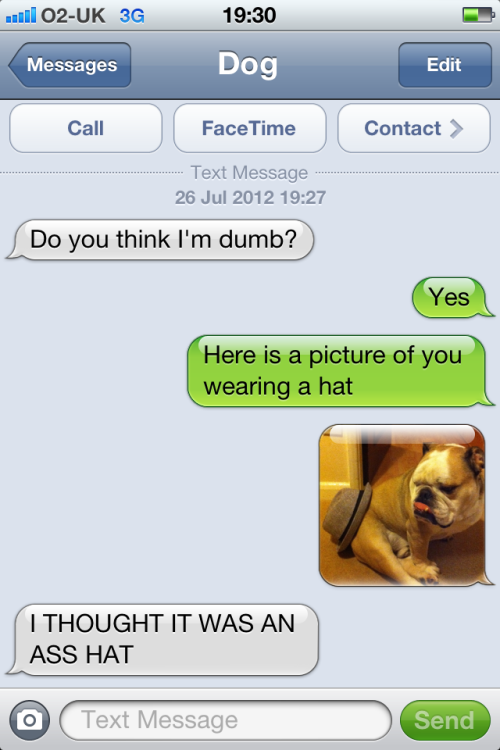

 Pies urodził się na farmie w Walii. Najsłabszy z pięciorga psiaków w miocie, został sprzedany jako ostatni. To sprawiło, że był zrzędliwy już od najmłodszych lat. Kiedy miał 13 tygodni w końcu wylądował w wielkim mieście (Birmingham), gdzie spędził osiem długich i rozczarowujących lat swojego życia. Pies poświęca swój czas na zrozumienie świata, który go otacza. Jego zainteresowania to  spanie, jedzenie, gapienie sie tępo w próżnię, i okazyjne obszczekiwanie rzeczy, które się przewróciły. Ostatnio nauczył się pisać SMSy. Ta wiedza dodała kolorytu jego życiu, bo dzięki niej może wnerwiać swojego wstrętnego i olewczego właściciela 24h na dobę. Co więcej, Pies zwalcza przestępczość na pół etatu.

Wednesday, 31 August 2011

.:Poles Sick and Tired of Elections?:.

Greetings!
As usual - long time no see, but I promise, I'll work on this inconvenience ;]
Let's get to the point. Polish governmental elections are looming in, therefore, I've translated for You a very interesting article about the approach and attitude of Poles towards this important event.
[Thanks to Raf Uzar for providing some improvements to this text :]
The original article can be found HERE.
Hope you'll enjoy it!
---
Tłumaczenie: Krystian Iwaniuk

.:Are Poles Doomed to Tusk?:.

Genuine elections, or just yet another masquarade?

Poles are seemingly fed up with the incessant fight between Poland’s two main parties – Civic Platform (PO) and Law and Justice (PiS). However, in practice they dismiss all other parties that are trying to force their way into this political battle. “This has lasted for so long that we have to acknowledge the fact that it is a phase in history, which may even last for several years,” forecast Mariusz Janicki and Wiesław Władyka of Polish weekly Polityka.

Poland - First to Fight!

They have analysed the election strategies of PO and PiS. Both columnists claim that Kaczyński’s party aims to dishearten those who voted for Donald Tusk’s party in 2007. This explains why PiS has created a negative atmosphere with visions of the end of the world and PO voters abandoning the Polish PM. Whereas PO, according to Janicki and Władyka, is struggling to break through this negative atmosphere and take the initiative. This could explain their need to introduce American-style debates.


Disheartening leader?

“It could be the most emotional and the least factual campaign ever, a peculiar festival of aggressive helplessness because increasingly more depends on global events, of which Tusk is aware, whilst Kaczyński still pretends not to know,” according to the two journalists.

Moreover, Janicki and Władyka think that despite the fact that Poles are discouraged by the fossilised political scene, and by the fact that the spotlight is constantly focused on PiS and PO, they continue to dismiss new parties attempting to enter the political scene. “In some way this duel fascinates Poles, in some way it reflects the cultural and ideological division of Poland. The fact that this impasse still lasts shows that we are witnessing a process that reflects society,” state the Polish columnists.

Poles aren't ready for 'modern politics'? [Here, Janusz Palikot]

What is more, the Polityka journalists assume that such a political situation may last for years. “The division in Poland, which appeared and became increasingly defined after 2005,  reflects a deeper and genuine truth about Polish society. It gives us an overall picture of Polish society. This picture will not change until society changes. This impasse cannot be avoided without descending into political infantilism. The scenery may have changed but the actors, emotions and their ‘visions of democracy’ have not,” they conclude.

Awaiting the Improvement? 


Friday, 29 April 2011

.:Wywiad z Trentem Reznorem:.

Witam!
Chwilę mnie tu nie było, ale mam nadzieję, że ten wywiad 
trochę osłodzi Wam naszą rozłąkę ;]
-
Przetłumaczyłem dla Was wywiad prosto z amerykańskiego 
Rolling Stone [znajdziecie go tu] przeprowadzony
z multiinstrumentalistą i mózgiem kultowego Nine Inch Nails - 
Trentem Reznorem!
A w wywiadzie wiele pyszności: Trent opowie nam m. in. o ceremonii wręczania Oscarów,
Beatlesach, swoim nowym projekcie i co gra swojemu synkowi na dobranoc...
ENJOY!!!
---
 Tłumaczenie: Krystian Iwaniuk
Oryginał: Austin Scaggs

Trent Reznor: "Chciałem zmusić siebie do napisania czegoś innego"


Nie nosiłem krawata od lat" przyznał Trent Reznor (46 l.) ubrany w elegancki smoking prosto od Prady, gdy odbierał Oscara za najlepszą muzykę filmową. "Fajnie było na chwilę  wyjść z roli 'warczącego gościa wypruwającego się nad mikrofonem'”.
Reznor w 2009 r. zaszokował fanów Nine Inch Nails, ogłaszając, że zespół robi sobie przerwę na czas nieokreślony.  Od tamtego momentu, wraz ze swym przyjacielem Atticusem Rossem, Reznor rozpoczął intensywną współpracę z reżyserem Davidem Fincherem – tworząc m.in. muzykę na miarę Oscara do The Social Network oraz do nadchodzącej ekranizacji powieści Stiega Larsson Mężczyźni, którzy nienawidzą kobiet. 

How to Destroy Angels: Atticus Ross, Mariqueen Maandig i Trent Reznor

W zeszłym roku Reznor wraz z Rossem wydali EPkę swojego nowego projektu zwanego How to Destroy Angels, na której pojawiła się również żona Trenta, Mariqueen Maandig (która powiła Reznorowi zeszłej jesieni syna). "Będąc z żoną w jednym zespole jestem świadomy ogromu rzeczy, które mogą pójść nie tak", przyznał Reznor, obiecując wydanie longpleja swojego nowego zespołu jeszcze w tym roku. "Jesteśmy najlepszymi przyjaciółmi i interesują nas te same rzeczy, więc naturalnym jest, że tworzymy razem muzykę. Pełnienie roli bardziej drugoplanowej i co za tym idzie, brak potrzeby bycia w centrum uwagi, jest właśnie tym, co mnie teraz najbardziej kręci".


Główny temat muzyczny The Social Network nosi tytuł “Hand Covers Bruise”. Dlaczego?
Musiałem wymyślić 18 tytułów piosenek w ciągu jednego dnia. Stanąłem przed zadaniem typu „Nie nazywajmy utworu ‘Mark biegnie przez kampus’” [śmiech]. Kiedy rozmyślaliśmy nad tym, jak ta muzyka będzie brzmieć, jeden z utworów  już nosił nazwę “Hand Covers Bruise”. Wydał się nam idealnie pasującym do tego tematu.

 Ross i Reznor

Spodziewałeś się, że wygrasz [Oscara]?
Myślałem sobie “Pewnie nie wygram, ale jeśli wygram, mam nadzieję, że nie zrobię z siebie idioty”. Niepokój rośnie. Następnie uświadamiasz sobie, że nie jadłeś od 12 godzin. A kamery skierowane są praktycznie cały czas na ciebie. „Muszę podłubać w nosie! Ale nie mogę ryzykować…” Potem słyszysz niczym w zwolnionym tempie swoje imię. „Dobra, przytulić żonę. Nie potknąć się o kabel. Dlaczego robię dwa kroki na raz? Potknę się, ale nie mogę się zatrzymać. O boże, tam jest Nicole Kidman, ona ma ze 3 metry wzrostu. Czy mikrofon jest włączony?” Po milisekundzie jest już po wszystkim, a ty stoisz za kulisami z Oscarem w ręku.


 To słowo jest nadużywane w szczególności, jeśli chodzi o Oscary, ale kogo uważasz za geniusza?
To oczywiste – The Beatles. Gdy dorastałem nie lubiłem ludzi, którzy lubili the Beatles, więc nie zwracałem na ten zespół uwagi. W okolicach  nagrywania The Downward Spiral zacząłem się naprawdę wkręcać w okres White Album Beatlesów, i tak ta fascynacja zaczęła się pogłębiać. Wyprzedzali całą konkurencję tak daleko, że to było wręcz nie fair. Również Prince miał na mnie ogromny wpływ – to, co potrafił stworzyć bez niczyjej pomocy.

Dokładnie 20 lat temu przygotowywałeś się na swoją pierwszą trasę Lollapalooza. Jakie są twoje najżywsze wspomnienia z lata 1991 roku?
Nasz teledysk leciał wtedy na MTV, nasze piosenki były grane w radiu i któregoś dnia odebrałem telefon: “Jane's Addiction chce byście zagrali z nimi na tym nowym festiwalu.” Nasz pierwszy występ, w Arizonie, trwał półtorej piosenki. Pamiętam, jak zobaczyłem profesjonalne case’y na sprzęt Living Colour prosto z Guitar Center, no i te ich błyszczące stroje z lycry, podczas gdy ja miałem jedynie jasnoniebieski kabel, który ojciec podarował mi na gwiazdkę, jak miałem 15 lat. Wtedy w Arizonie było z 40oC, kabel się stopił i nasz koncert dobiegł końca. Po prostu pobiegłem z powrotem do busa. Potem były lepsze koncerty.

Reznor podczas jednego z koncertów  Lollapalooza' 91

Jaką muzykę grasz swojemu synkowi?
Gram mu głównie na fortepianie: Bach, Beethoven i Mozart, odrobinę Chopina. Oraz puszczam mu nagrania odgłosów macicy i suszarki do ubrań, które pomagają mu zasnąć. Pewnie pokocha filmy Davida Lyncha. Jego pokoik  jest wypełniony dźwiękami rodem z  Eraserhead [śmiech].


Na tweeterze pisałeś ostatnio, że oglądając stare nagrania NIN, zatęskniłeś za koncertowaniem. Kiedy NIN znów wyruszy w trasę?
Powodem, dla którego przestałem koncertować z Nine Inch Nails jest to, że chciałem zmusić siebie do napisania czegoś innego. NIN jest dla mnie ‘wygodne’, jest czymś znanym. Lubię te piosenki, lubię  je śpiewać, lubię tę energię na scenie, ale nie jest to teraz dla mnie tak istotne, jak wtedy, gdy miałem 25 lat. I jest jeszcze ta  niewypowiedziana presja by wciąż koncertować – jest to jedyny sposób by zarobić na życie. Patrzę  na odwagę Davida Bowiego w zmienianiu i wymyślaniu samego siebie na nowo. To wymaga odwagi. Mimo to, ta przerwa nie będzie trwała wiecznie. Chęć wyruszenia znów w trasę, w pewnym stopniu, powróci w przeciągu kilku następnych lat.


Nine Inch Nails  podczas koncertu w Hasselt, Belgia, 18.08.2007

Monday, 14 March 2011

.:Little Secret:.

 Welcome back!

Today I've translated for you a very interesting story 
about a teacher, who had a very peculiar secret...
Original PL article can be found here.
Enjoy!!!
---
Translation: Krystian Iwaniuk
Original: Małgorzata Szlachetka/ Gazeta Wyborcza

.:Little Secret:.


Maciej Białek has been a teacher for 18 years – he cannot see for 12. He’s been gradually losing his sight. For the first four years he concealed this fact, because he was afraid of losing his job.

In one of the secondary schools in Bronowice, Poland, a history lesson begins. Attendance list is being checked by one of the students. She marks absences in a class register. Later on, this data will be entered by a school librarian to an electronic register.
A historian, Maciej Białek, tells about reigning of the first Piasts throughout 45 minutes of the lesson. He doesn’t use any notes, and when he wants to draw a contour of Poland he asks students whether a blackboard is wiped clean.
Maciej Białek has been losing his sight gradually. He has worked as a teacher for 18 years, whilst he cannot see for 12. For the first four years he concealed this fact because he was afraid that he will be dismissed. Only few people knew the truth. “I lived in the same neighbourhood where I worked. I’ve known the layout of the school. I’ve just tried to walk slower and be more careful. Nevertheless, it happened a few times that I hit a post, stumbled over a pavement, or a neighbour thought that I was drunk because I tottered a bit,” tells Białek.

He resorted to a simple trick in the school. “I asked a caretaker to nail a hook on a board, which hung in a teacher’s room, at a height of a key no. 12. Thanks to that, I knew, by counting, where are the other ones,” explains Białek.
The whole truth was revealed at a school trip, when Maciej stepped on a dress of one of his colleagues, and hit something else afterwards. He heard that someone said: “You’re walking like a blindman.” Then he told the truth. He didn’t lose his job. Moreover, he has as many duties as the other teachers, with the only difference that he is not a class tutor.
At first sight it is extremely difficult to figure out that the teacher is blind. During a discussion he turns his head towards an interlocutor, he does not use a white cane at school, and when he goes down the stairs he does not even touch a banister. Out on town he does not use any help of a guide. He highlights that young people, especially his students, treat him very well. “We have an agreement that there is no cheating during the tests. But when I catch somebody red-handed, because I will hear a rustle of turning pages, I have no mercy – he gets an F!”

What is a loss of sight? Maciej Białek calls it “the end of the world.” The most difficult thing for him was to learn to ask others for help. Till this day he regrets that he cannot see a screen in the cinema, because until he was six years old he lived by the Grunwald cinema, closed down years ago. In the beginning, he could not get used to the fact that he cannot read. He had to stop his doctoral studies, as well as give up playing bridge. “I was the only blind person who was buying books to wait for better timesMy friends chipped in to my first talking computer. Thanks to the advanced technology it is a lot simpler to live: if I want to read a book I scan pages and the computer converts the print into words,” says Maciej Białek. However, equally often it happens that his friends or family read his students' tests to him.
Blind people can also dress themselves to match a colour thanks to a device resembling a remote controller. They press it to their clothes and they can hear its colour.
How to handle a talking computer taught him years ago a man, who came specially for him from Warsaw. The man was blind as well, but despite this issue he brought up three sons only by himself. Moreover, he was not afraid of any physical effort: he liked rock climbing, tried horse riding. “He was a model to me,” admits Maciej.
What Maciej did not have to give up? Such pleasures as cooking for friends or travelling abroad.


For GW Anna Woźniak-Szymańska, a president of Polish Association of the Blind (PZN).


“Unfortunately in Poland only 15-17% out of all blind people has a job. This indicator in Europe reaches 50%. There is a view in Poland which still lingers on – that if somebody is blind he has to stay at home and draw a pension. After all, losing a sight does not mean that someone has lost his knowledge.”

Monday, 28 February 2011

.:Sex Instead of a Lunch:.

Hullo!
So, to kick off yet another beautiful week
I have translated for you a letter.
It describes how buisness-Poles blindly adapt some
Western fancy, hip etc. trends (here - sex trend).

Here you can find the original PL text taken from Wysokie obcasy.

Enjoy!  
---
Translation: Krystian Iwaniuk
Original: Anka

.:Letter of the Week:.


My girlfriends from work instead of a lunch with their colleagues choose sex – in toilets or a nearby park.

I work in a big company, I have a family – for the time being I still have a husband and a child. The question is for how long I will have my husband by my side, because the child will be always with me. I would like to know, am I of a normal kind of people or rather of dinosaurs which will become extinct in a near future. Until recently, I have been coming to my job with pleasure, acquiring new skills and climbing up the corporate ladder. I am still developing there, but I just can’t stand the habits, which started to prevail there lately.

Sex for lunch. That’s, in short, how can be described the activity which, besides social networking websites, occupies my work colleagues' time. My girlfriends from work instead of a lunch with other colleagues choose sex – in a toilet, in a nearby park, under a bridge, in a car etc. They aren’t attached to a particular guy, so it can’t even be called an affair. That’s how those who have families are living, those for whom it's hard to getaway on weekends. They, who aren’t in stable relationships, also realize their fantasies on weekends, at random parties – and it becomes a topic of chats and e-mails at work. They exchange their experiences and information about which colleague can last longer than others or which is better at oral sex.
 And what are YOU having for lunch today?

Advising on whom you should sleep with is blooming. Should you choose that manager or rather someone else? And may it endanger your career? More discreet are women who have families. They are young, in their twenties, and have no inhibitions.

I learned from my friends that my company is not an exception – it’s a common habit in jobs involving great stress. Once there were smoking rooms, now employees should think about organizing special sex rooms for those who prefer sex to lunch.

I have the impression that while men are able to reconcile their careers with such pleasures, women just can’t. Those ladies who are more active during lunch breaks do not apply themselves to work, are not promoted, do not receive any awards, they are at a standstill. Nevertheless, they keep their positions thanks to those men, who  make use of their "services".

Is it really a place to make a sweet love?

Saturday, 26 February 2011

.:To Break Free of Death’s Grip in the Land of Smiles: Part II:.

 I keep my word and present you
the second part of the interview with
Michał Pauli.

Here you can read the original PL text.
Enjoy :]
---
TranslationKrystian Iwaniuk
OriginalKinga Matałowska


"If the guards had known this, I would have been in a helluva trouble."


- How did you manage to break free?

It was a long-lasting process. After my third fruitless appeal I hit on an idea to write to influential, significant people in Poland to ask them for support. I discussed this through with our embassy, but they told me straight that they can’t do a thing without a permission from the Polish Ministry of Foreign Affairs’ (MSZ).

- So what is left in such a situation? Wait for a miracle to come?

I suppose that in such terms my amnesty should be considered. Although I had to help this miracle to come by writing another letters. First what I had done was writing letters to MSZ, Radosław Sikorski [Polish Minister of Foreign Affairs] and several other significant politicians, who left my letters unanswered.
            The breakthrough happened when my mom and I had written two letters asking to support my amnesty to Lech Wałęsa. And he signed it. Other sympathetic people who signed it were Aleksander Kwaśniewski and – to my surprise – Lech Kaczyński. However, both were spurred to signed it by their wives, to whom I have addressed the letters counting on female empathy. When we collected the signatures Polish ambassador handed them personally to a royal secretary.

 Pauli's painting titled "Pu Chai"

- What did you feel when after those years of imprisonment you were free and you could live a normal life outside the prison walls?

World changes. I spent years in a place, which technologically reminded the Stone Age period: no electronics, no communication other than mail, no computers or phones – that’s one thing. The other is that life in prison deprives you of humanity and ability to live in a civilised world. You waste there time on obtaining  stuff which will allow you to survive, you’re not doing anything developing. When you leave prison you are like a child – everything makes you happy and frightens you at the same time.
            Already on a plane to Poland I had a pretty funny situation. In those big Boeings you have a small telly and a joystick to control it, so I grasped it and started to play with it. At one point a cable pulled out, and I didn’t know what to do with it. I called a stewardess and asked her how to put the whole thing in. She looked at me as if I was an idiot, pull the cable towards herself and it all just hid. It’s a kind of silly thing, but life is based on such silly things, and the lack of some abilities may simply terrify you.
            Well, after returning to Poland seeing the technological development was really surprising. And all those traffic jams. These are the things which you don’t notice so much on daily basis, but when you come back from such a place like a Thai prison they simply astound you.

Giving food at a prison square

- You are a visiual artist. Did you use your talent behind the bars?

In prison I made sketches which illustrate my book. I drew them with a pen on obtained scraps of paper. If the guards had known this I would have been in a helluva trouble. We smuggled them so that they could see the light of a day. Such sketches are the only documentation from those prisons – taking pictures is forbidden. There is no gear to take them there, anyway.

­- In spite of all what you have experienced, would you say that you have gained anything from it?

I think so. „What doesn’t kill you makes you stronger” – I am a living proof of truthfulness of this maxim. What I’ve experienced changed my world view, and convinced me that I can subconsciously have an impact on reality. I was in a hopeless situation. I was just a grain of sand being  poured from one bag to another. Back then, every single day I imagined that I’m coming back home.
            Also I have discovered a thing which people call "the will to survive". Einstein said once that everybody says that something cannot be done until there comes an individual, unaware that it cannot be done, and actually does it. That's how it was in my case.
            Things I’m saying right now are wisdom, which we learn in extreme situations. You know, people break down because of various things: lack of money, unemployment… I’m happy just because of the fact that I am here and can live another day. Of course I care about my own living standards, to keep my ass warm. But I can always say: ‘OK! It didn’t work out, but I can go somewhere else and find a job there.’ It can’t be helped, it may be hard, but I will live another given day. The day which wouldn’t have to come.
           
SkyTrain station

- Please tell us about paintings which you have here.

It’s a series of “postcards,” which  is interrelated with my book. 12 x śmierć. Opowieść z Krainy Uśmiechu [12 x Death. A Story From the Land of Smile] is about my prison vicissitudes, and the paintings recall my positive memories from Thailand, which I have a lot. Look, you can see in them a SkyTrain station, a little girl, monks, tuk-tuk, which is a symbol of Bangkok’s streets. I wanted those paintings to be different from the story, which is in detail told in this book. I’ve described there the dark side of the Land of Smile. In the paintings I show its smile, which I  remember so vividly.


- Have you noticed any changes in your sensitivity to art, colours, understanding of   space after coming back to Poland?
I think that it remained unchanged because it’s a thing which one either has or hasn’t got. My technique has changed for sure. However, with painting is like with riding a bike. If you pass a certain stage, you’re experienced in it, your technique may become blunt for a moment, but it all comes back after a while. For sure I have lost multitude of time, which now I have to make up.
- How did your book come to being?
I returned to Poland in 2009. My friends were encouraging me to write down or tell someone all what happened to me. I’ve written this book to commemorate all those who were left there. I started writing in February and finished it in August. I was writing really fast because I didn’t have to make anything up by the sweat of my brow – I just focused on relating to the facts, enclosing the whole content in a narrative form. It was a kind of a katharsis to me.
Front cover of Pauli's book
- Have you written anything before?

I'm a visual artist. My Polish teachers would be really astonished if they knew that I’ve written a book.
- What are your plans for future?
I would like my book to become a warning for those, who may by accident get into similar troubles, which I have experienced. I really want to help, in any way, those who already got into them.
            I will get back to painting that’s for sure. Another theme which I will work on will be Cambodia’s landscapes. I also would like to paint a series of “postcards” from Angkor – it’s a city founded by the Khmer civilization - amazing place! I was really impressed by tress there, which were as if taken from Beksiński’s paintings, as well as architecture resembling the Aztec pyramids surrounded by a jungle. I’ve been there years ago, but it still is in my head.
            I’m also thinking about making a painting reportage about Bangkok. I have a lot of photos, which I use to remember myself those real-world elements and transfer it onto canvas. I will put them on my website (www.michalpauli.pl).